
How to Find Anchorage Municipality Arrest Records
There is no single Anchorage arrest database, so a good search uses a few official tools together. For court charges tied to an arrest, you search CourtView. For custody status after a booking, you use VINE Alaska. For an official rap sheet, you go to the Department of Public Safety. Each tool answers a different question, and none of them replaces the others.
Start with what you know: a name, a possible case number, or a booking date. Then work the right source for the question you are asking.
- Search CourtView by name to find a recent criminal case and its charges.
- Check VINE Alaska for current custody status at a state facility.
- Open the case and read the Party Charge Information and disposition.
- For a formal background check, use the Department of Public Safety process, not CourtView.
- Contact the arresting agency or the prosecutor's office for arrest report details that are not online.
Anchorage Arrest Reports and Recent Bookings
An arrest generates a police report long before any court case develops. In Anchorage, those reports come from the Anchorage Police Department, or from the Alaska State Troopers outside city limits. A police report is not a court record, and it does not appear in CourtView. To get an arrest or incident report, you file a request with the agency that made the arrest, and some details may be held back while a case stays open.
Recent bookings are easier to confirm through custody status than through a public log. Anchorage has no county sheriff publishing a daily arrest blotter, so there is no official roster of overnight bookings with photos and charges. For a person held at the Anchorage Correctional Complex, VINE is the official place to check whether they are in custody.
Arrest Records vs Criminal Court Records
An arrest record and a criminal court record are not the same thing. An arrest is the event: police take a person into custody and book them. A criminal court record is the case that may follow. One can exist without the other. The comparison below lays out the difference.
| Feature | Arrest Record | Criminal Court Record |
|---|---|---|
| What it is | A booking event | The court case that follows |
| Who keeps it | Police and the Department of Corrections | The Alaska Court System |
| Where to find it | Arresting agency, VINE custody data | CourtView case search |
| Shows guilt? | No, an arrest is an accusation | Only at the charge disposition |
For the full case side, the Anchorage court records page covers how to read a criminal case in CourtView.
What Anchorage Arrest and Criminal Records Show
Pieced together, arrest and criminal records cover the path from booking to disposition. The exact fields depend on the source, but the core facts repeat. CourtView holds the court side, and the arresting agency holds the booking side.
- Identity - the name and, on court records, party role.
- Charges - the offense alleged, plus any amendment later.
- Case number - the 3AN case if charges were filed.
- Custody status - whether the person is held, released, or transferred.
- Disposition - the outcome, from dismissal to conviction and sentence.
The court warns that the case type "Criminal" covers both misdemeanors and felonies, so the level is clear only once you read the charge detail.
Charges vs Convictions in Anchorage Cases
This is the single most important distinction on the page. A charge is an accusation. A conviction is a finding or a plea of guilt that the court accepts. CourtView itself cautions readers not to assume a defendant was convicted just because a case was filed. A charge can be amended, reduced, or dropped along the way.
| Point | Charge | Conviction |
|---|---|---|
| Meaning | An accusation by a prosecutor | A finding or plea of guilt accepted by the court |
| Stage | Filing and arraignment | Disposition |
| Can it change? | Yes, it can be amended or dismissed | Final unless appealed or set aside |
| Where to confirm | Party Charge Information | Party Charge Disposition |
So the disposition is the field that matters. Read it before you draw any conclusion about an Anchorage criminal record.
Mugshots and Booking Photos in Anchorage
Anchorage does not run a county sheriff mugshot gallery, because the municipality has no county jail. Booking photos taken at the Anchorage Correctional Complex are state Department of Corrections records, and the official sources do not expose a public, searchable mugshot roster with charges and bond. Many private sites repost old mugshots, but those are not official and are often out of date.
For custody confirmation, VINE Alaska is the official tool, and it focuses on status rather than photos. For charges and court dates, CourtView is the source. The Anchorage inmate records page covers the custody side in full.
Be careful with private mugshot websites. They scrape old booking photos, charge people to take them down, and rarely update when a case is dismissed. None of them is an official Anchorage or Alaska source. A photo on one of those sites does not prove a current charge, a conviction, or that the person is still held anywhere.
Who Prosecutes Crimes in Anchorage
Two offices prosecute most Anchorage crimes, and which one depends on the charge. State crimes, including felonies, go to the Anchorage District Attorney's Office in the Department of Law. The Anchorage District Attorney's Office is the largest in the state's Criminal Division, with specialized units for domestic violence, sexual assault, and major crimes.
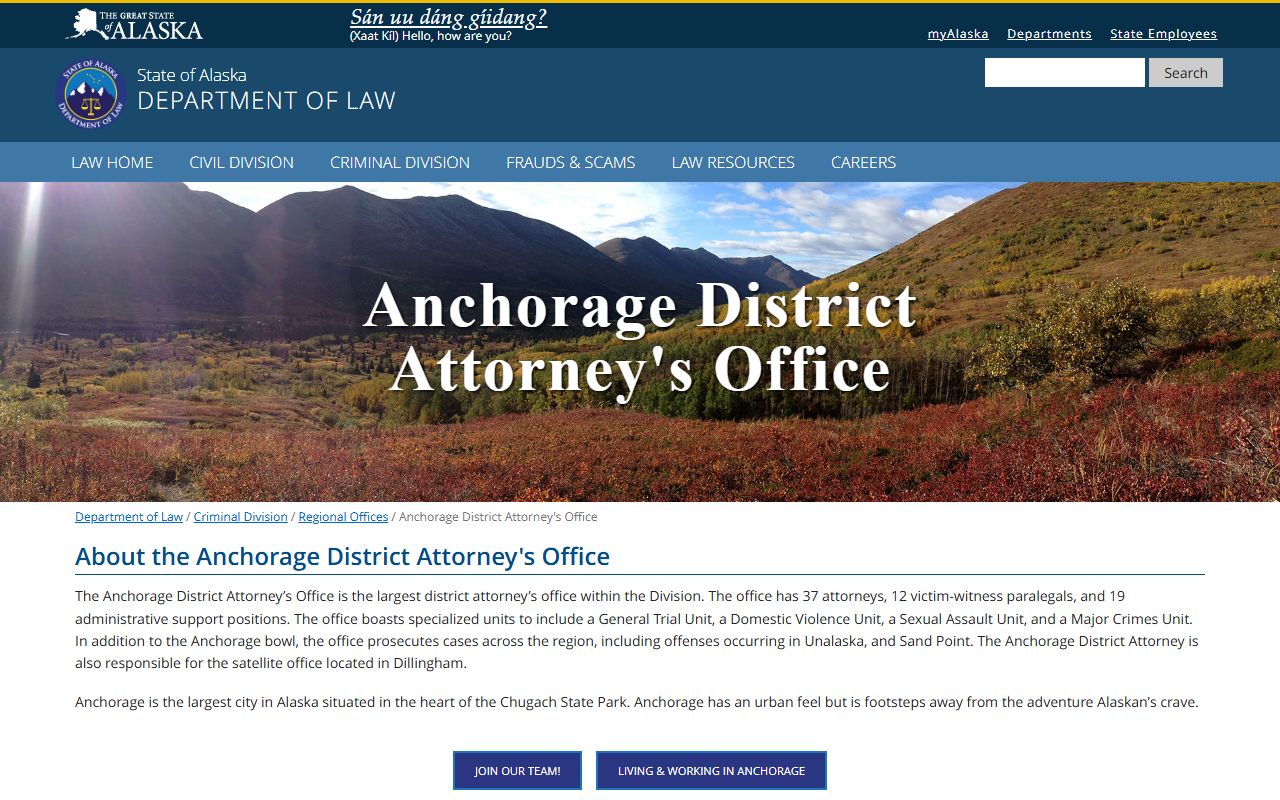
You can view the Anchorage District Attorney's Office page for its address, units, and contact details. Municipal misdemeanors are a separate track.
Municipal misdemeanors are prosecuted by the Anchorage Municipal Prosecutor, based at City Hall. The office handles charges like driving under the influence, assault, theft, and trespass within the municipality.
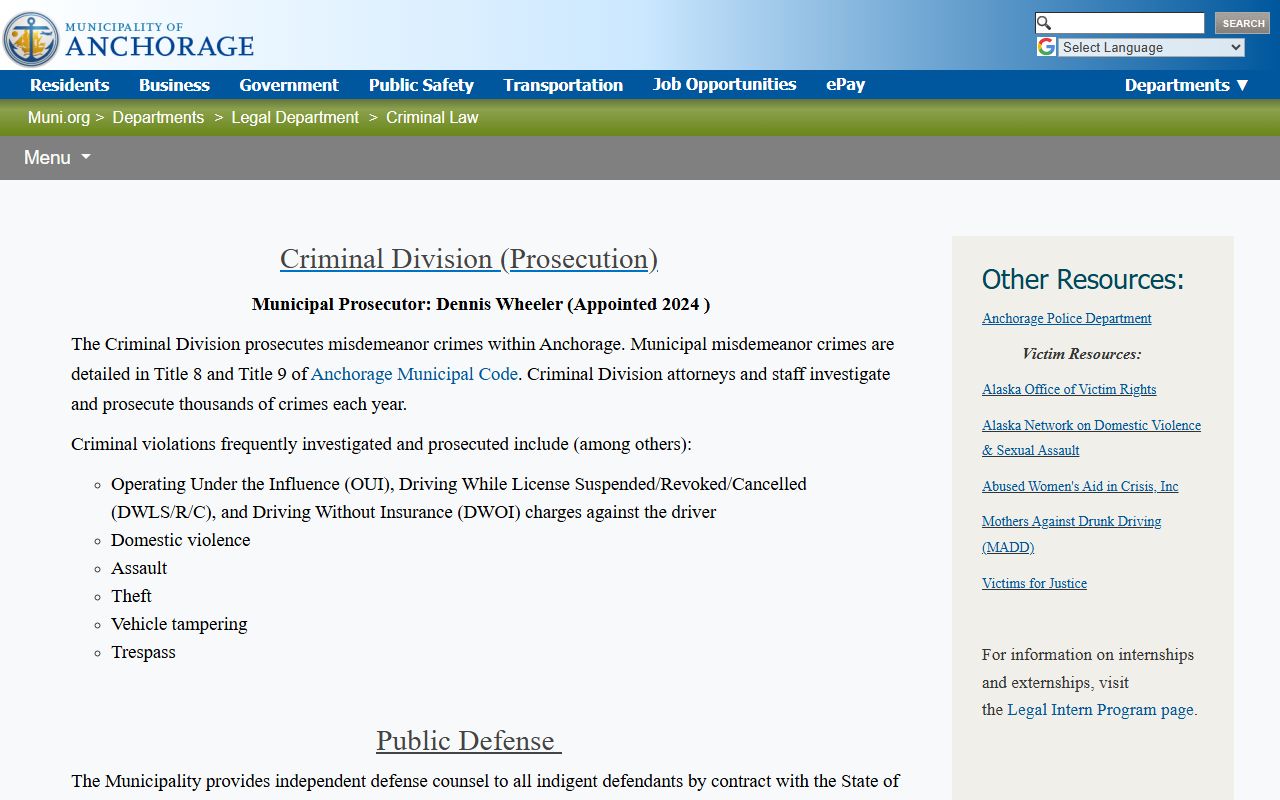
The Anchorage Municipal Prosecutor page explains the misdemeanor scope and gives a useful warning: missing an arraignment on a driving charge can lead to a bench warrant.
Federal Criminal Charges in Anchorage
Some Anchorage cases are federal, not state or municipal. Federal crimes are prosecuted by the U.S. Attorney's Office for the District of Alaska, which has an Anchorage office. Federal arrest and case records do not appear in CourtView; they run through the federal system instead.
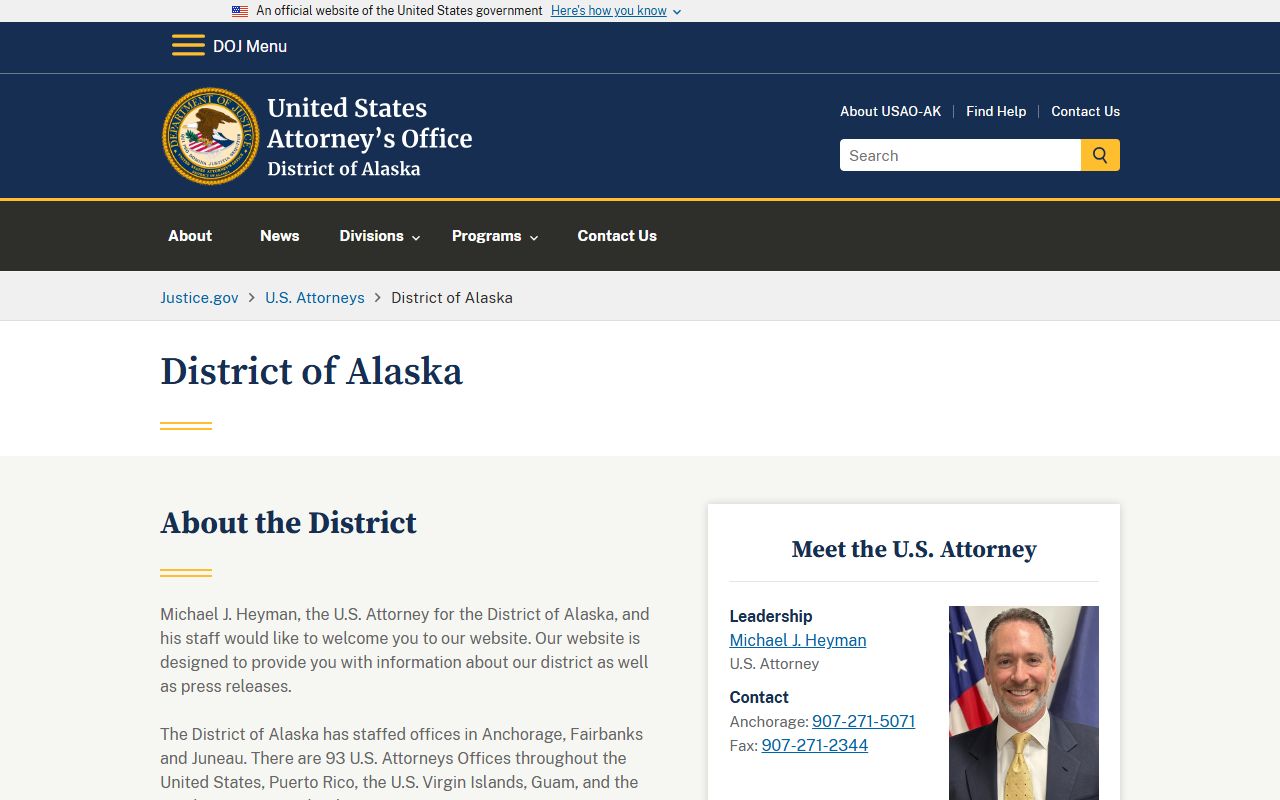
The U.S. Attorney's Office for the District of Alaska handles federal prosecution statewide from Anchorage, Fairbanks, and Juneau. Contact details are posted separately.
For the courthouse side of federal cases, the federal courts page covers the U.S. District Court and PACER. You can also reach the U.S. Attorney's Office through its contact page.
Official Alaska Criminal History
A CourtView search is not a criminal history check. The official rap sheet for Alaska comes from the Department of Public Safety, which runs name-based and fingerprint-based checks for a fee. State law governs how that criminal justice information is released and used.
The split matters for anyone doing a background check the right way. CourtView shows court cases, with gaps and removals. The Department of Public Safety holds the central record. Employers and licensing bodies that need a formal result use the state process, not a court index or a private site.
The Department of Public Safety offers two kinds of checks. A name-based check searches by identity. A fingerprint-based check is more exact and is the standard for many license and employment screenings. Each carries a fee, and the rules for releasing this criminal justice information sit in state law. A result from the Department of Public Safety carries weight that a CourtView printout does not, because it draws on the central criminal history rather than a court index.
Note: This site is not a consumer reporting agency, so its information cannot be used for employment, tenant, or other FCRA-regulated screening.
Sealed vs Expunged Records in Anchorage
People often mix up sealing and expungement. They are not the same, and Alaska is not a broad automatic-expungement state. Sealing or removal limits access; expungement is the narrow destruction or correction of information. The comparison shows how each one works here.
| Point | Sealed or Removed | Expunged |
|---|---|---|
| What happens | Access restricted, or case off the online index | Information destroyed or corrected |
| Alaska basis | Court rules and the 60-day online removal rule | A narrow statute for limited cases |
| File still exists? | Often yes, at the courthouse | Removed from the agency record |
| Who decides | Court order or court rule | The agency head, with appeal available |
Expungement under Alaska law mostly covers situations like mistaken identity or a false accusation. To pursue it, you write to the agency that holds the information.
Defense Counsel and Confidential Records
People charged in Anchorage who cannot afford a lawyer may qualify for appointed counsel. The Alaska Public Defender Agency handles many cases, and the Office of Public Advocacy steps in when there is a conflict. Both have Anchorage offices.
You can see the Office of Public Advocacy criminal defense section for its Anchorage address and staff. Note that some criminal-adjacent files stay confidential. Juvenile delinquency and mental commitment records, for example, are not public, and an outstanding warrant may not show on any public list.