
How to Search Anchorage Municipality Court Records
The main tool for Anchorage court records is CourtView, the public access website run by the Alaska Court System. Because the Anchorage Superior Court and District Court are part of that one state system, CourtView holds the trial court case index for the whole municipality. You can search by name, by case number, or by ticket and citation number. The state warns that a CourtView search is not a criminal history check. Some records never show up there, and some drop off the index after a set time under statute, court rule, or court order.
Before you start, it helps to know what you have. A full name with a few spelling variants works for a name search. A case number works best when you have the whole string, dashes and leading zeroes included. Anchorage case numbers usually begin with the prefix 3AN.
- Open CourtView at the Alaska trial court search page and pick a search tab.
- Enter a party name, or type the full case number such as 3AN-12-00001CR.
- Narrow the list by case type, case status, or a file-date range.
- Open the case and read the Party Charge Information and disposition before you draw any conclusion.
- Request a copy of a document with form TF-311 ANCH if you need the filing itself.
The official Search Cases landing page links both the trial court search and the separate appellate case search. Start there if you are not sure which court heard the matter.
CourtView Search Fields for Anchorage Cases
CourtView gives you three public tabs and a long set of filters. The Case Number tab is the default. The Name tab lets you search a person or a company, and the Ticket/Citation tab works for traffic and minor offense cases. The CourtView information page explains how each field behaves and why some cases are missing.
| Field Label | Type | Required | Notes / Format |
|---|---|---|---|
| Case Number | Text | Yes on the case tab | Full format with dashes and leading zeroes, such as 3AN-12-00001CR. |
| Last Name | Text | No | Partial last names are supported; try a few spellings. |
| First Name | Text | No | A first initial or a nickname like Bob for Robert can help. |
| Case Type | Multi-select | No | Filter by Criminal, Civil, Estate, Small Claims, Traffic, and more. |
| Case Status | Multi-select | No | All Statuses, Open, Closed, or Reopened. |
| Ticket Number | Text | No | On the citation tab; you can also search a driver or vehicle license. |
One search returns at most 500 cases. If a common name pulls too many results, add a date range or a date of birth range to cut the list down. Page links sit at the bottom right of the results screen.
The Anchorage Court System and Judicial Structure
Alaska runs one court system for the whole state, so Anchorage does not have county-run courts. The system has four levels. Anchorage sits in the Third Judicial District. The Alaska Court System structure page lays out what each court does.
Case flow: District Court › Superior Court › Court of Appeals › Alaska Supreme Court
The two trial courts do most of the day-to-day work. The Superior Court is the general trial court. It hears felonies, larger civil cases, family law, probate, guardianship, and juvenile matters, plus appeals from the District Court. The District Court is a limited court. It handles misdemeanors, city ordinance cases, small claims, traffic, first appearances, and the issuing of warrants. The state structure page is mirrored on screen below.
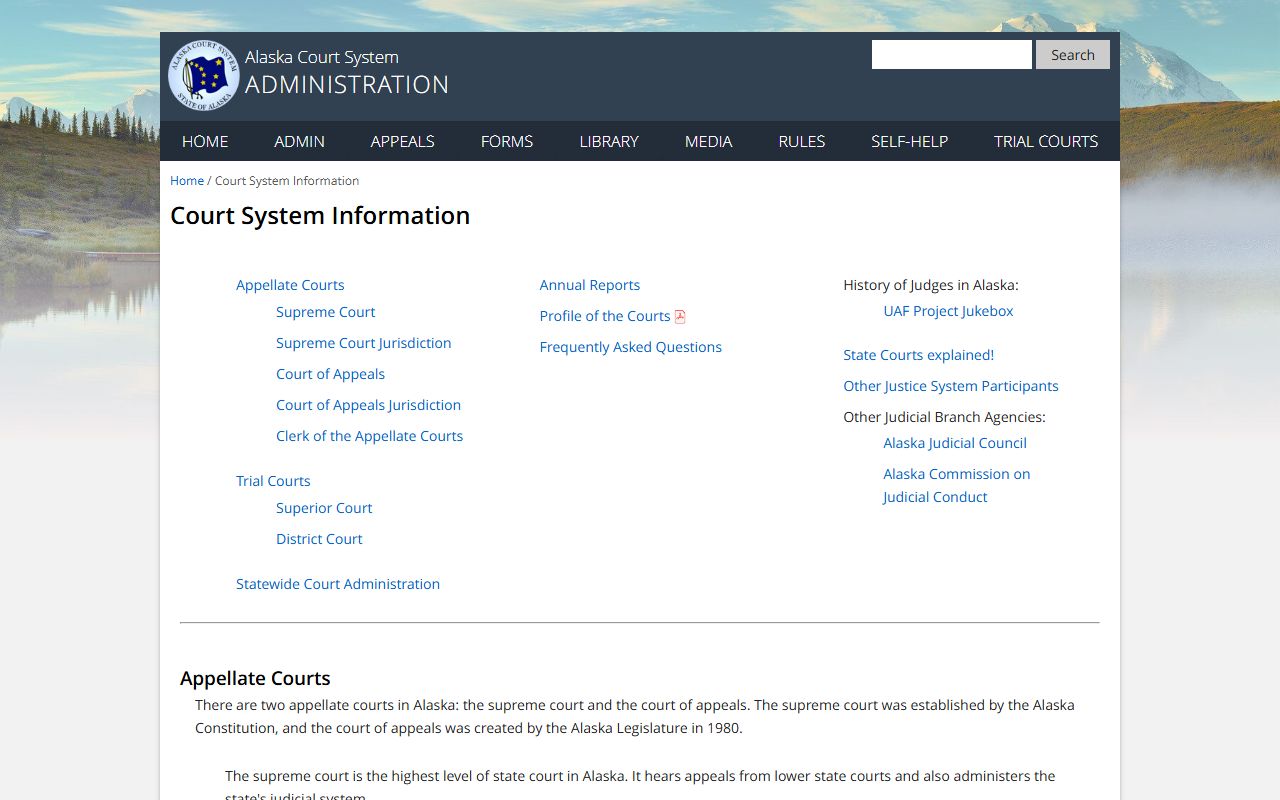
This screen sums up jurisdiction for each level. The table below pairs each court with the cases it hears.
| Court | Jurisdiction | Case Types |
|---|---|---|
| Alaska Supreme Court | Highest state court | Final civil appeals; court administration. |
| Court of Appeals | Criminal appeals | Criminal cases, post-conviction, sentencing, bail, parole. |
| Superior Court | General jurisdiction | Felonies, major civil, family, probate, juvenile, guardianship. |
| District Court | Limited jurisdiction | Misdemeanors, small claims, traffic, warrants, first appearances. |
Anchorage Municipality Courthouses
Court users in Anchorage deal with two downtown buildings. The Nesbett Courthouse at 825 W. 4th Avenue is the main address for the Anchorage Trial Courts. The Boney Courthouse at 303 K Street handles grand jury work, weekend name-change hearings, and several therapeutic courts. The Alaska Court System keeps a full Anchorage directory with department phone numbers and hours.
You can see that directory online before you go. Open the Anchorage court directory to check a phone number, a fax line, or the records desk hours.
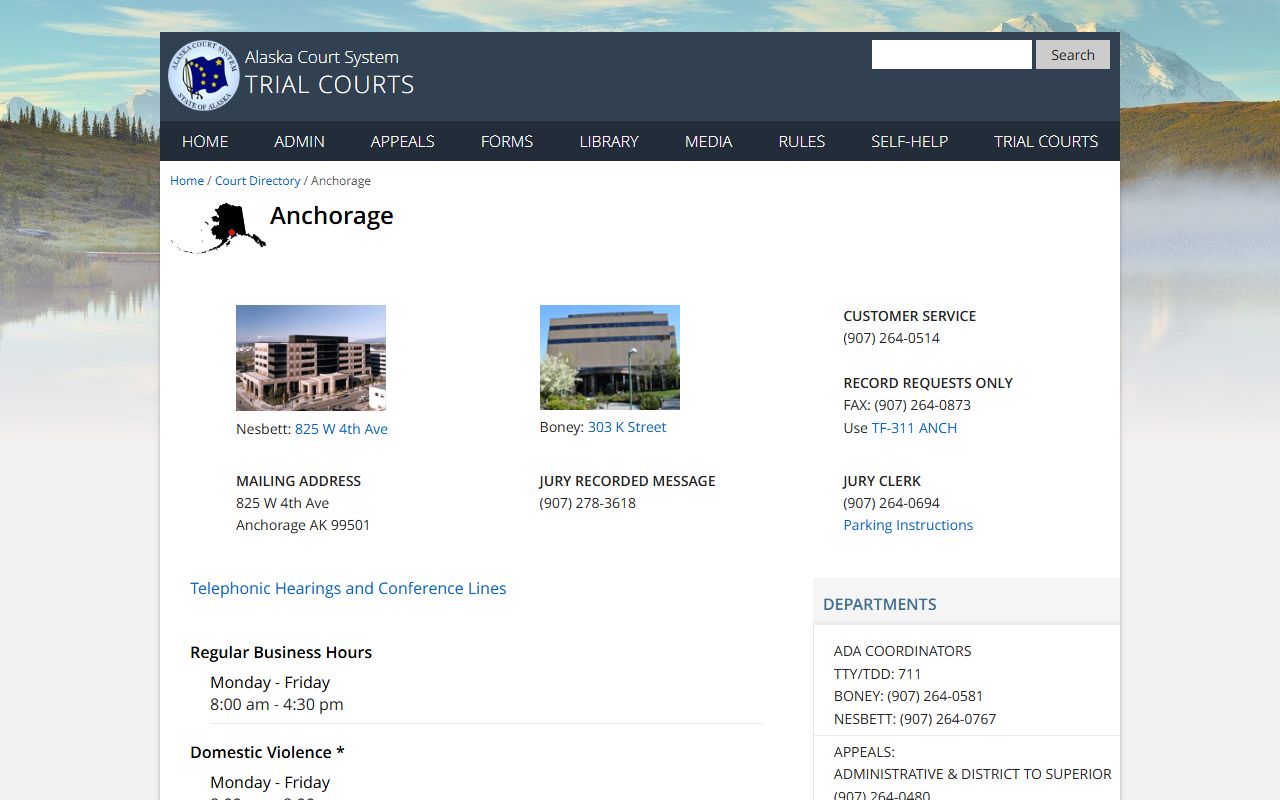
The directory shows both courthouse addresses and the direct lines for each department. Regular hours are Monday through Friday, 8:00 a.m. to 4:30 p.m.
Types of Anchorage Municipality Court Records
The Alaska Court System keeps a wide range of case files for Anchorage. The list spans criminal, civil, family, probate, and traffic matters. Some are open to anyone. Others are confidential by rule or statute.
Which court made the record depends on the case. Felonies and big civil suits sit in the Superior Court. Misdemeanors, small claims, and traffic cases sit in the District Court. The Alaska trial courts page covers copy requests and the filing reports for each.
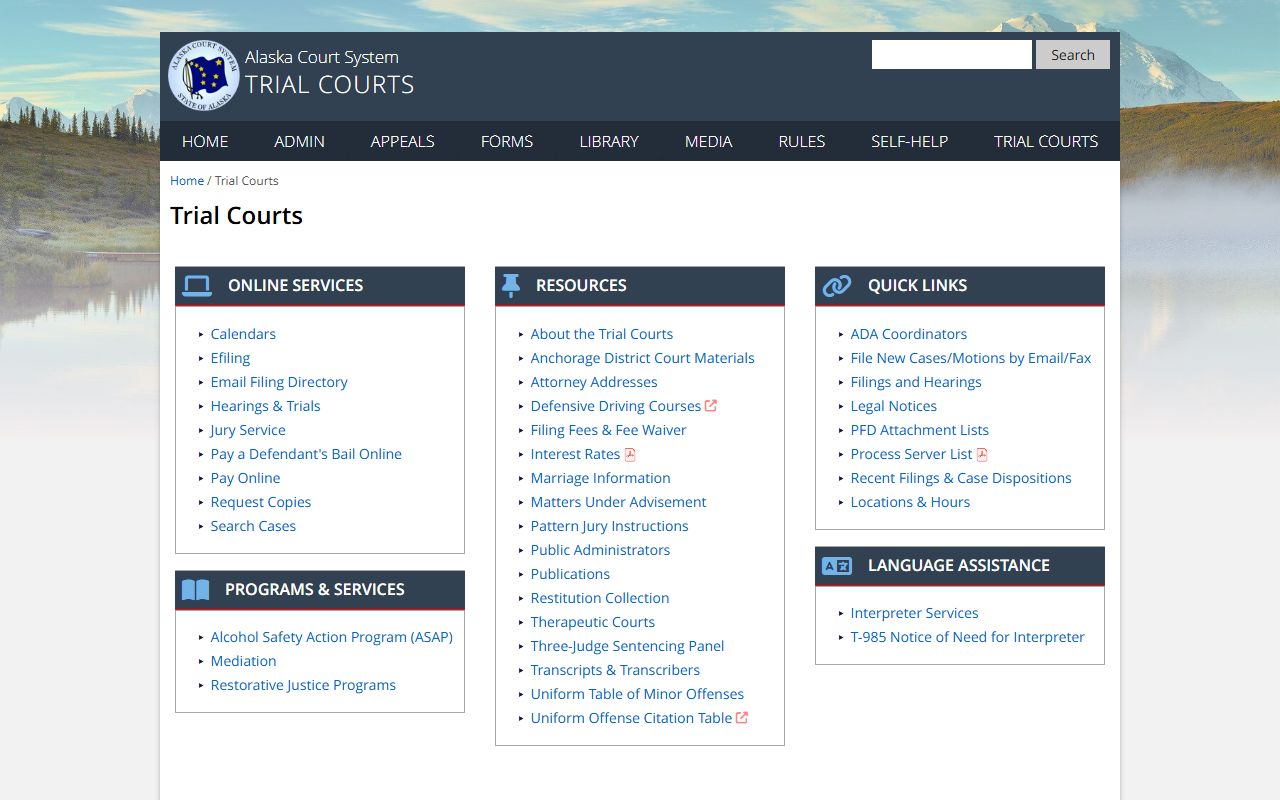
That trial courts page also links the audio recording and search warrant record forms. Here are the main record groups you will find:
- Criminal records - felony and misdemeanor cases, charges, pleas, and dispositions.
- Civil records - debt, evictions, name changes, protective orders, and judgments.
- Family records - divorce, dissolution, custody, and support, with some parts restricted.
- Probate records - wills, estates, trusts, and guardianship, some of it confidential.
- Traffic records - citations, fines, and minor offense cases in the District Court.
What Anchorage Municipality Court Records Show
An Anchorage court record packs a lot into a short index entry. The case number alone tells you the court, the year, and the case type. The prefix 3AN marks an Anchorage case. The suffix marks the kind of case, such as CR for criminal, CI for civil, or PR for probate. A will deposited for safekeeping ends in WI.
| Field | What It Shows |
|---|---|
| Case Number | Location prefix, year, sequence, and suffix, such as 3AN-12-00001CR. |
| Parties | Names and roles like plaintiff, defendant, petitioner, or personal representative. |
| Case Type | Criminal, civil, estate, small claims, traffic, or domestic relations. |
| Charges | Charge information and the charge disposition in criminal cases. |
| Docket | Dated entries for filings, hearings, orders, and judgments. |
| Financial | Fines, fees, restitution, and any amount sent to collection. |
CourtView does not let you download the filed documents themselves. For the actual paper, you request copies from the Records Department. More detail on each field sits on the Anchorage court records page.
Public Access Laws for Anchorage Court Records
Alaska gives the public broad access to government records, but court files follow their own set of rules. The Alaska Public Records Act covers most agency records. Court records are governed mainly by the Alaska Court System Administrative Rules and Rule 40, while criminal justice information falls under a separate statute. A record can be public at the courthouse yet still not appear in CourtView. That gap matters when you cannot find a case online.
Key Statutes:
Alaska Statutes § 40.25.110 - public records are open to inspect and copy during office hours, and fees stay near the cost of duplication.
Alaska Statutes § 40.25.120 - lists the exceptions, such as adoption, juvenile, and some medical and law-enforcement records.
Alaska Statutes § 22.35.030 - keeps some acquitted or dismissed criminal cases off the online index after 60 days.
Administrative Rules 37.5 through 37.8 set how court records, electronic records, and remote access work. Rule 40 explains which cases drop off the public index. The Alaska Public Records Act guide from the Department of Law is a good plain-English start.
Records That Are Sealed or Confidential
Not every Anchorage case is open. The TF-311 ANCH records form lists seven confidential case types: adoption, child in need of aid, conservatorship, delinquency, guardianship, minor settlement, and mental commitment. Only parties to those cases can get copies, and they must show photo identification to a clerk.
Sealed cases go further. Under the court rules, a sealed record is open only to the judge and to people named in a written court order. Court work product, such as a judge's notes and legal research, stays out of public view as well. Some criminal cases that ended in acquittal or dismissal come off the online index, though the paper file may still exist at the courthouse.
To view a sealed or confidential file, you usually need to be a party or file a motion asking the court for access. Alaska is not a broad automatic-expungement state, so a removed online entry does not mean the underlying record was destroyed.
Specialty Courts in Anchorage
Anchorage runs several therapeutic courts. These problem-solving courts let some people choose treatment and close supervision in place of a standard sentence. A team of court staff, lawyers, and treatment providers tracks each person through a multi-month program. The therapeutic courts overview explains the model.
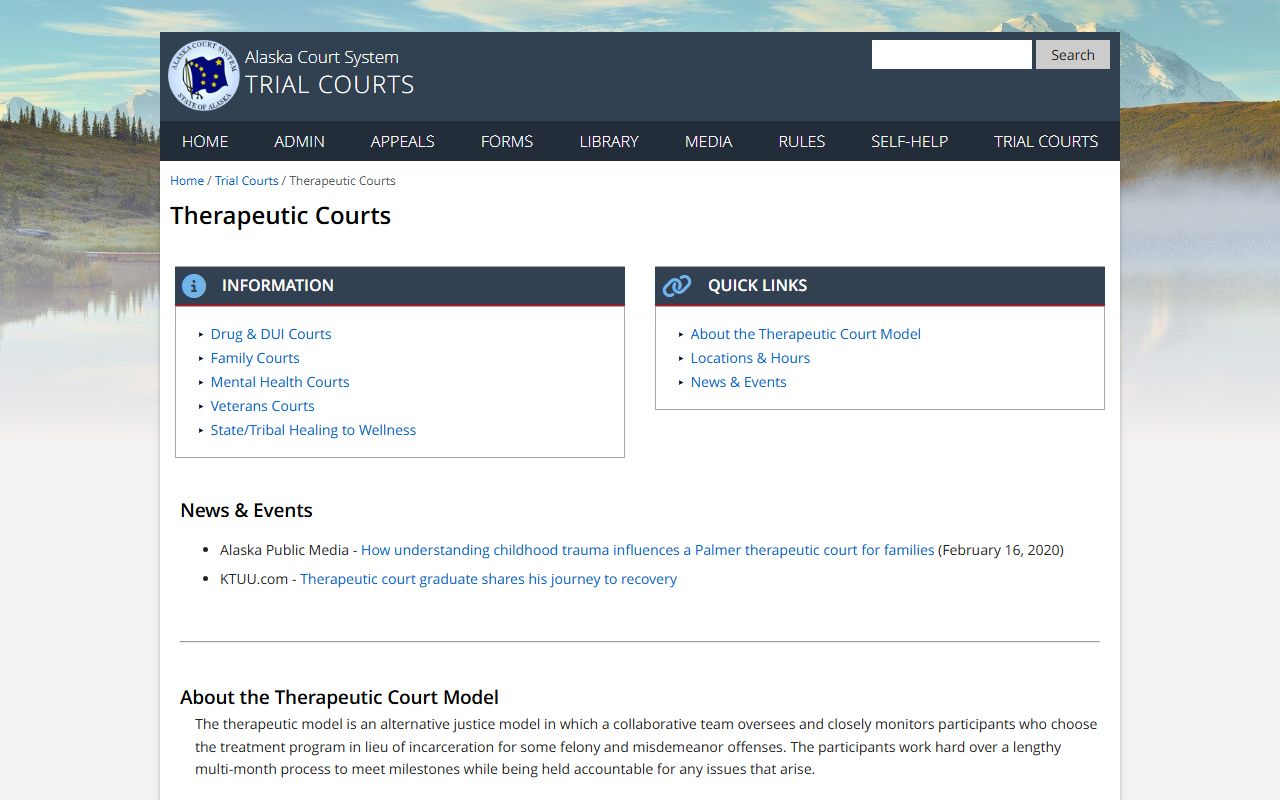
Anchorage has a Mental Health Court, a Veterans Court, a Family/CINA Therapeutic Court, and felony and misdemeanor wellness courts. Each meets on set days in the Nesbett or Boney courthouse. The court system lists every program with its meeting time and location.
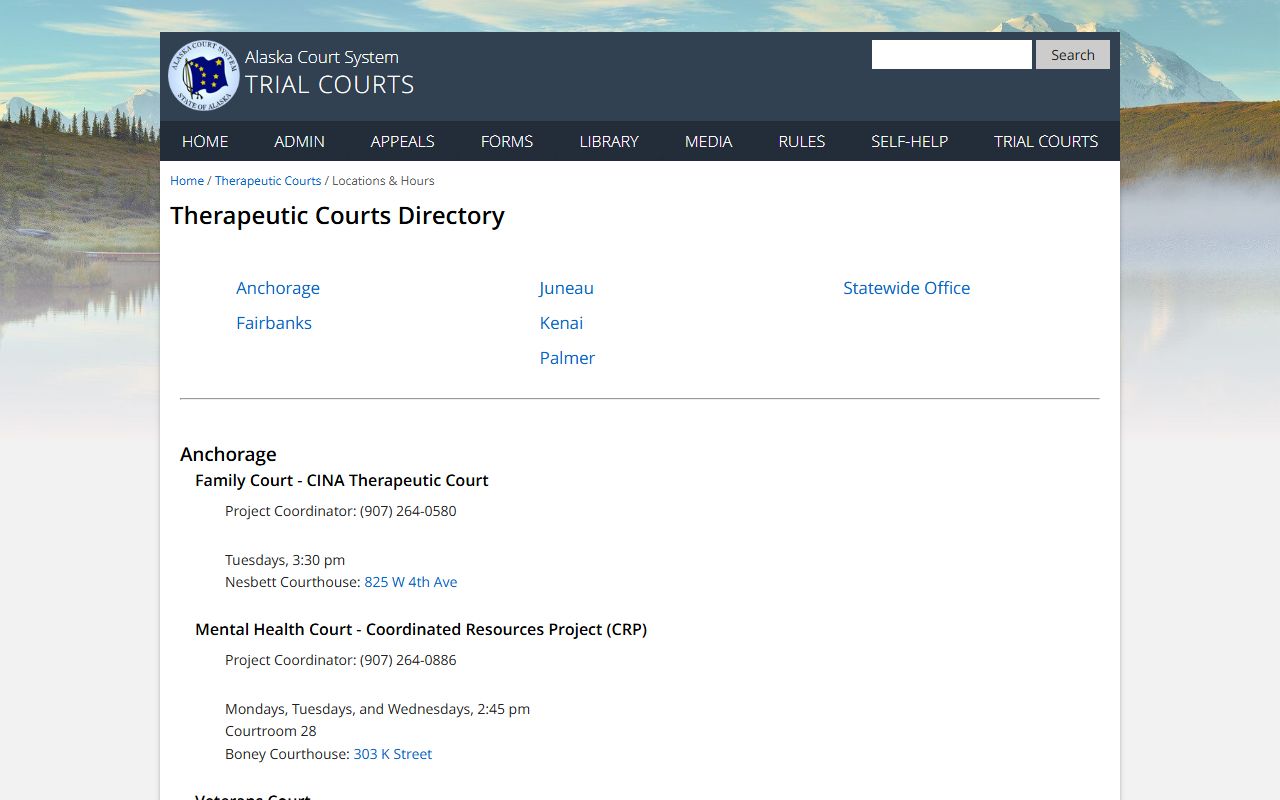
The Mental Health Court meets in Courtroom 28 at Boney. The Veterans Court meets Mondays at Boney. Because several of these programs touch confidential case types like child in need of aid, the public index may show little about them. The therapeutic court locations page has the current schedule.
Anchorage Custody, Jail, and Warrant Lookups
Anchorage has no county sheriff and no county jail. Custody is handled by the Alaska Department of Corrections, and local policing is handled by the Anchorage Police Department. The main local lockup is the Anchorage Correctional Complex, a state facility. For custody status, the public tool is VINE, the Alaska custody search and notification service.
For the full roster details, see the Anchorage inmate records page. To check for an outstanding warrant, see warrant records, and for charges and court dates use the court records search. There is no official public Anchorage warrant list, so CourtView and direct calls to the court are the safer route.
Marriage, Divorce, and Probate Records
Anchorage handles family and probate cases through the Superior Court, but marriage licensing is different. The Anchorage and Juneau courts do not issue marriage licenses. Couples get the license from the local Health Analytics and Vital Records office instead. Divorce and dissolution cases are filed with the court, and you can request a decree copy through the records process. See the marriage and divorce records page and the probate records page for the full steps.
- Testator
- The person who makes a will.
- Personal Representative
- The person the court names to settle an estate.
- Conservator
- A person the court appoints to manage another person's money or property.
Anchorage Court Records Fees
The court charges set fees for copies and filings. The fee schedule is published statewide and applies to the Anchorage Records Department. A plain copy of the first document costs $5, with $3 for each more document asked for at the same time. A certified copy is $10 for the first and $3 for each added certified copy of the same document.
| Item | Amount |
|---|---|
| Plain copy, first document | $5 |
| Certified copy, first document | $10 |
| Exemplified or authenticated copy | $15 per document |
| Records research | $30 per hour, one-hour minimum |
| Audio recording CD | $20 per CD |
| Divorce or dissolution filing | $250 |
You can confirm current amounts on the state fee page. View the Alaska court fee schedule for filing fees, copy fees, and fee waiver rules.
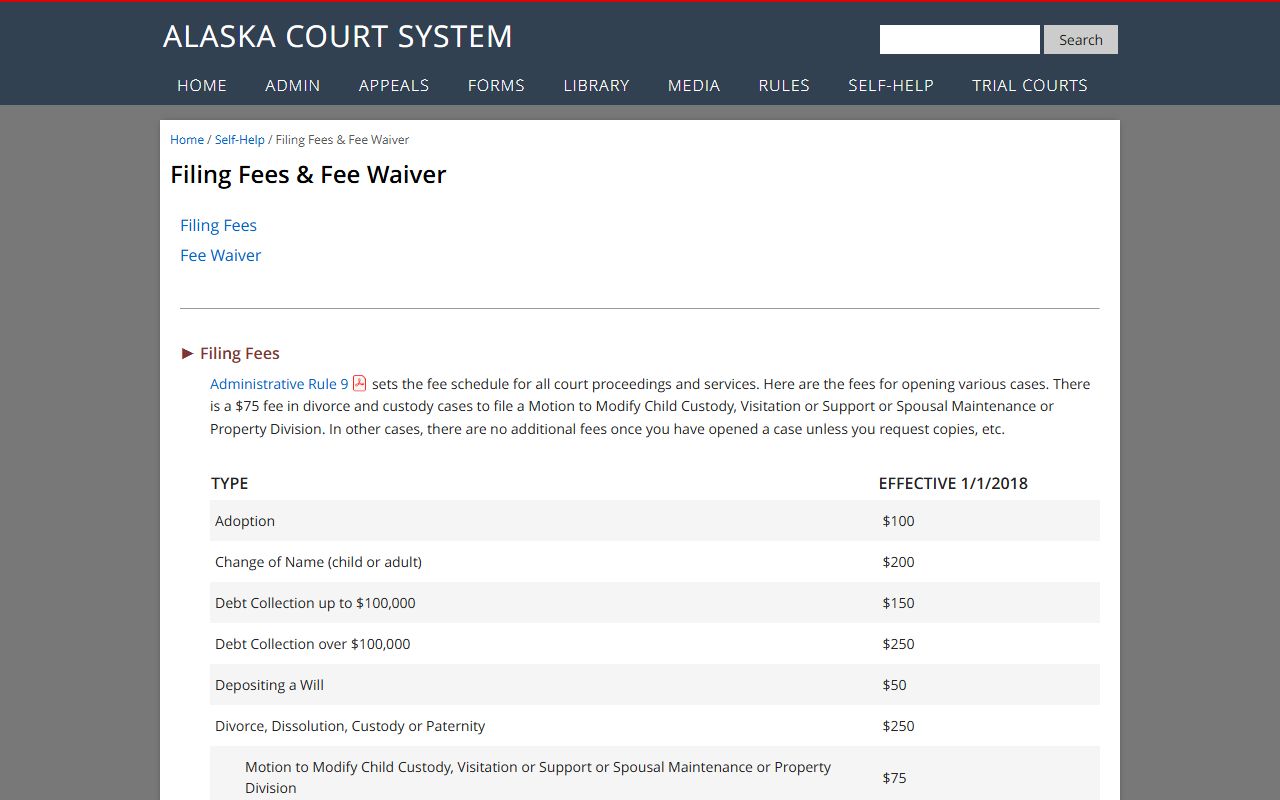
The same page covers fee waivers for people who cannot pay. Protective orders for domestic violence, stalking, and sexual assault carry no filing fee.
How to Read an Anchorage Court Record
A court case can read like code at first. The case number prefix 3AN means Anchorage. A two-digit year and a five-digit sequence follow. The suffix tells you the case type. In a criminal case, the word "Criminal" covers both misdemeanors and felonies, so you have to open the case and read the charge disposition to know the level and the outcome.
Do not assume a filed case ended in a conviction. A charge can be amended, dropped, or dismissed. The disposition is the part that tells you what really happened. A few terms come up again and again.
- Disposition
- The outcome of a case or a single charge.
- Arraignment
- The first court appearance, where a defendant hears the charge and enters a plea.
- Bench warrant
- A warrant a judge issues, often after a missed court date.
The court dockets page breaks down the docket entries in more depth.
Accuracy and Record Limitations
Online court data can lag behind the paper file. Events show up in CourtView only for hearings held after the system went live in a given court. Some cases are removed from the index by rule even though the file still exists. A green Pay button can appear on a case, yet that does not always mean money is still owed.
Note: Always confirm a case detail with the Anchorage Records Department or the originating office before you rely on it for any legal or formal use.
History of the Anchorage Courts
Anchorage's court setup grew out of Alaska statehood in 1959. The state constitution created the Alaska Supreme Court, and the legislature added the Court of Appeals in 1980. The legislature also set up the District Court for each judicial district at statehood. Anchorage landed in the Third Judicial District.
The two downtown courthouses carry the names of early Alaska Supreme Court justices. The Nesbett Courthouse honors Buell Nesbett. The Boney Courthouse honors George F. Boney, who served on the high court from 1968 to 1972. The Appellate Clerk's Office sits in Anchorage, and the Supreme Court hears oral arguments here each month. CourtView, the online case system, is the more recent chapter and now anchors statewide trial court search and online payment.
Self-Help and Legal Aid in Anchorage
People without a lawyer have a few solid options in Anchorage. The Alaska Court System Self-Help Center covers family law, probate, small claims, and fee waivers. The Family Law Self-Help Center in Anchorage can be reached at (907) 264-0851. For civil legal aid, the Alaska Legal Services Corporation serves the area from a downtown office.
The court also offers language help. Court interpreter services are free, and you file a short form to ask for one. The state interpreter services page explains the process.
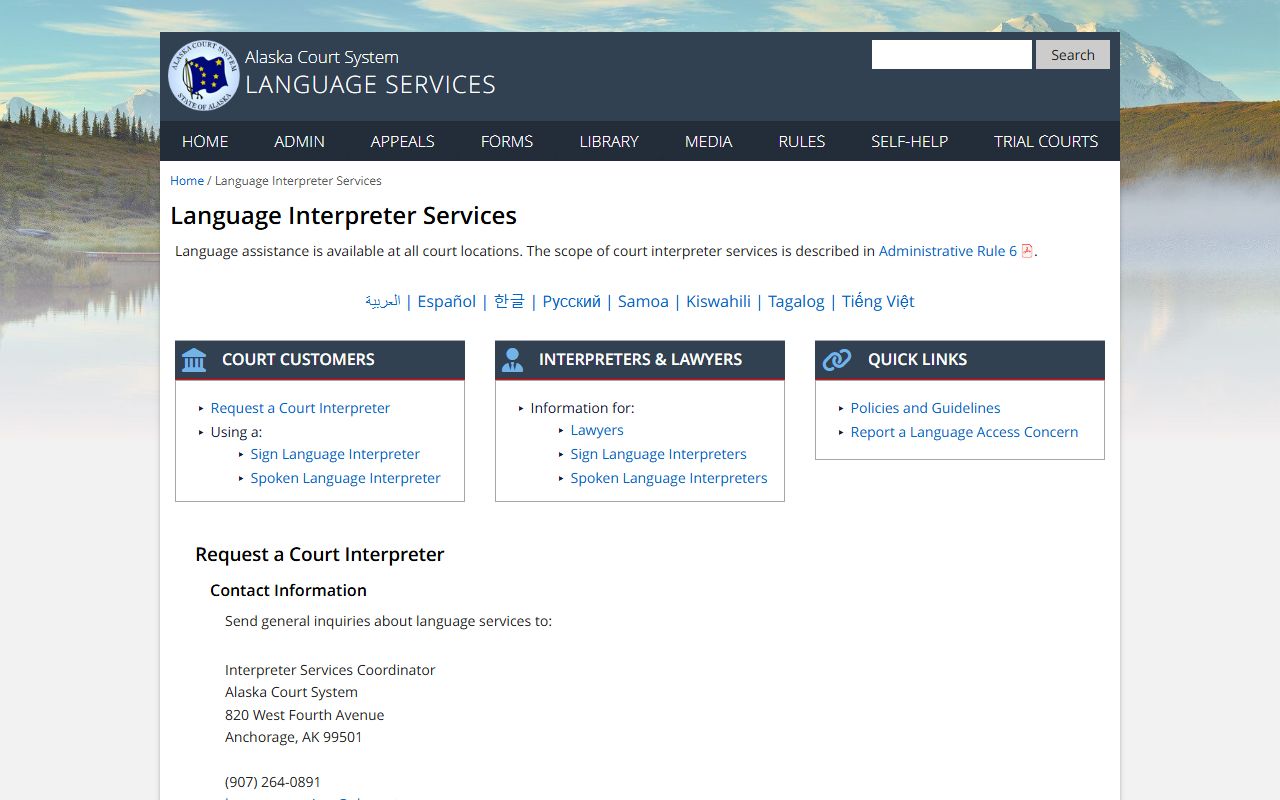
The interpreter services office is based in Anchorage at 820 West Fourth Avenue. You can read about court interpreter services or call the coordinator listed there. The Alaska Bar Association also runs a Lawyer Referral Service for people who want to hire counsel.
Frequently Asked Questions
A few questions come up again and again about Anchorage court records. Here are short answers, with the full set on the FAQ page.
Is CourtView a background check?
No. The Alaska Court System warns that a CourtView search is not a criminal history check. Some records never appear online, and others come off the index under statute or court rule. For an official Alaska criminal history, you use the Department of Public Safety process, not CourtView.
Does the Anchorage court issue marriage licenses?
No. The Anchorage and Juneau courts do not issue marriage licenses. Couples get the license from the local Health Analytics and Vital Records office. Most other Alaska courts do issue licenses, so Anchorage is a specific exception worth knowing.
Which cases does the Anchorage court keep?
The records form says Anchorage keeps cases that start with 3AN, 3SP, or 3ST. If a case number starts with a different code, the Anchorage court likely cannot pull it, and you have to ask the court that holds the file.
More on the Anchorage Municipality court records FAQ page.